Spring-to-Summer Transition Outfits for Men (18 Ideas)
The weeks between spring and full summer heat are the hardest stretch of the year to dress for. Mornings can start cool enough for a light jacket, afternoons swing into real warmth, and evenings drop again once the sun goes down — sometimes all in the same day.
Dressing for summer too early and you’re cold at 8 am; dressing for spring too long and you’re overheating by 2 pm.
This guide covers 18 spring-to-summer transition outfits for men built specifically around that problem: layers you can add or remove, fabrics that work across a wider temperature range than pure summer or pure spring pieces, and combinations that look intentional, whether you’re wearing all of it or you’ve already shed the jacket.
1. Unlined Field Jacket, Oxford Shirt, and Chino Trousers
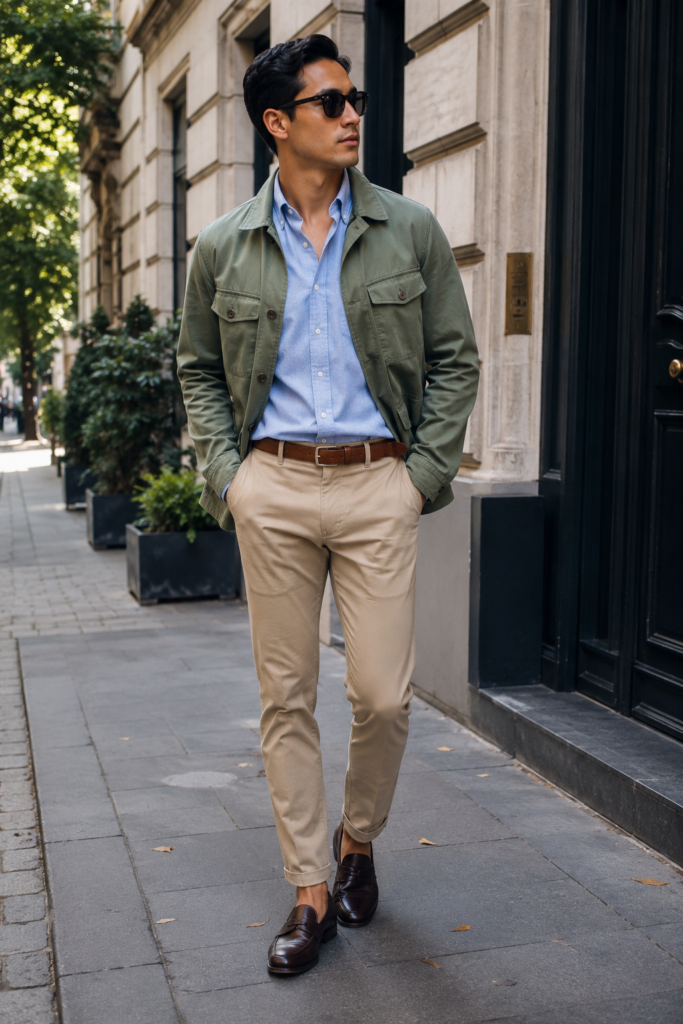
An unlined cotton field jacket, a lightweight Oxford button-down, and chino trousers is close to the perfect transitional outfit — enough structure to handle a cool morning, light enough to survive an afternoon without overheating once you find shade.
The word “unlined” matters here. A lined field jacket traps heat the way a real cold-weather coat does; an unlined version is essentially a heavier shirt with jacket styling, which is exactly the right weight for a day that starts at 55°F and ends at 75°F. Oxford cloth’s basketweave construction breathes reasonably well under the jacket, so you’re not overheating even with two layers on top.
Best for: cool mornings that warm up fast, office days with variable indoor and outdoor temperatures.
2. Denim Trucker Jacket Over a Tee, with Lightweight Chino Shorts

A denim trucker jacket, a plain tee, and lightweight chino shorts bridge spring and summer by pairing a genuinely warm layer with already-summer-ready shorts, so you can shed the jacket the moment it gets warm without changing the rest of the outfit.
Denim jackets run warmer than most transitional outerwear because of the fabric’s weight and density, so they’re best suited to real morning chill rather than a mild spring day where you’d overheat by 10 am. Keep the shorts light — a thinner cotton or cotton-blend chino — so the bottom half of the outfit is already dressed for the warmer afternoon, even while the jacket handles the cooler start.
Common mistake: wearing a heavy denim jacket with shorts that are equally heavy-weight. If the jacket’s doing the warmth work, the shorts should already be summer-ready underneath it.
3. Lightweight Bomber Jacket, Crewneck Tee, and Straight-Leg Jeans
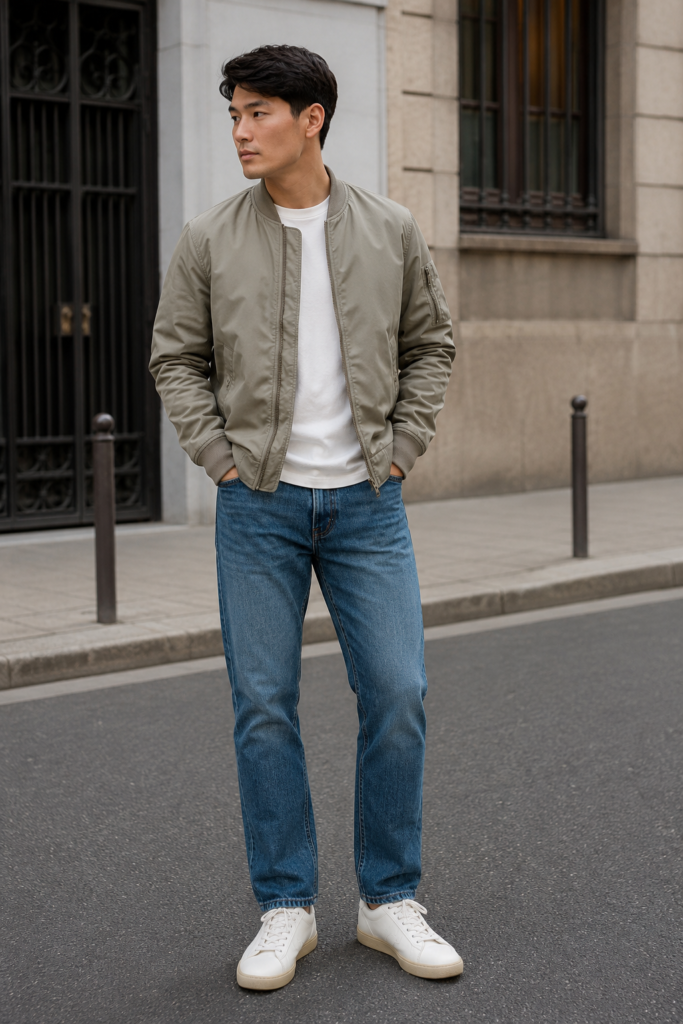
A lightweight nylon or cotton bomber jacket, a plain crewneck tee, and straight-leg jeans work for cooler transitional evenings, when temperatures dip enough that shorts and a tee alone aren’t quite enough.
Nylon or poly-blend bombers are considerably lighter than a traditional leather or heavy wool bomber, which matters for transitional weather, specifically — you want a jacket that adds warmth without adding real bulk or heat retention once the sun’s out. The ribbed cuffs and hem on a classic bomber silhouette also do genuine functional work, sealing in warmth at the openings better than a jacket with an open hem.
Best for: cool evenings, early-season outdoor events, transitional travel days.
4. Overshirt Worn Open, Fitted Tee, and Rolled Chinos
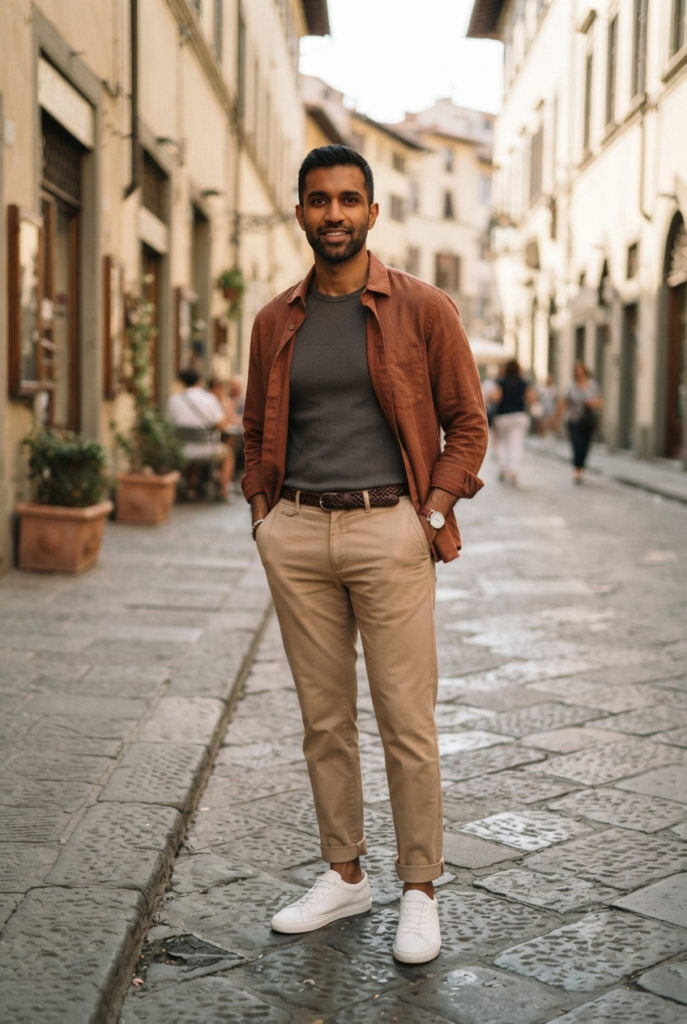
An overshirt (heavier than a dress shirt, lighter than a jacket) worn open over a fitted tee, with chinos rolled once at the ankle, might be the single most useful transitional outfit on this list because the overshirt genuinely works both open and closed.
Overshirts sit in a specific gap in weight and structure — heavier cotton or chambray, but without a jacket’s lining or shoulder padding — which makes them warm enough for a real morning chill when buttoned, and just an extra layer of texture when left open in the afternoon. This flexibility is what makes an overshirt outperform an actual jacket for transitional dressing; you’re not carrying dead weight once it warms up, since it can just be tied around your waist.
Best for: unpredictable transitional days, travel, any day where you don’t know exactly how warm it’ll get.
Read also: 12 Neutral Outfit Ideas for Men: Building a Minimal Wardrobe
5. Quarter-Zip Pullover Over a Tee, with Straight-Leg Chinos
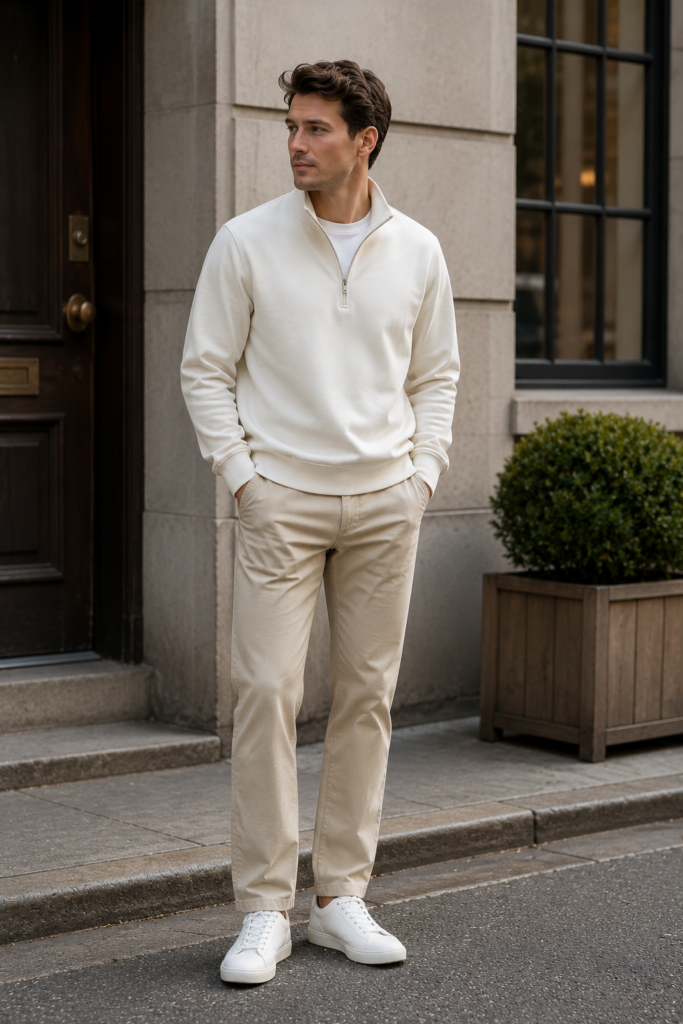
A lightweight quarter-zip pullover, worn over a plain tee, with straight-leg chinos, works well for a cool but not cold spring-to-summer morning, especially for casual office settings or weekend outings.
A quarter-zip’s partial zipper (rather than a full button-up or full-zip) means you get less bulk at the front than a full jacket, while still being able to adjust how much neck coverage you want as the temperature shifts through the day. Cotton or a cotton-blend quarter-zip breathes noticeably better than a full wool or heavy fleece version, which matters once the afternoon actually warms up.
Common mistake: choosing a quarter-zip in a heavy fleece for transitional weather. Fleece traps more heat than the temperature swing calls for — a lighter cotton-knit or technical quarter-zip performs better across a wider range.
6. Chambray Shirt Layered Under a Lightweight Sweater, with Chinos
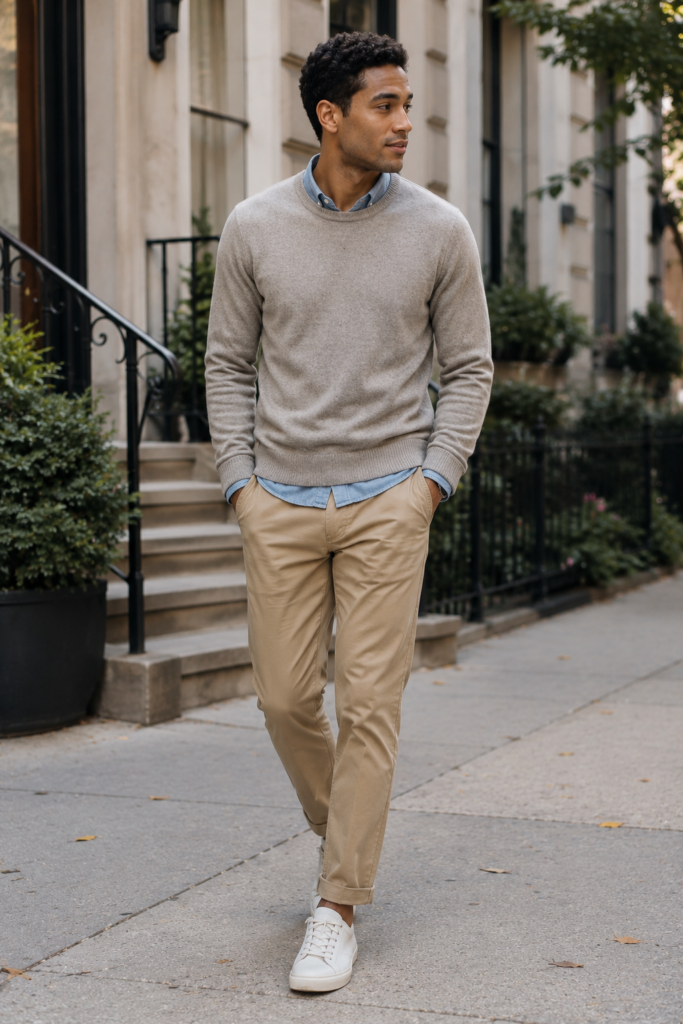
A chambray button-down, worn under a thin, lightweight crewneck sweater with the collar peeking out, paired with chinos, is a classic transitional combination that photographs well and adjusts easily — pull the sweater off midday and you’ve still got a complete outfit underneath.
The key detail is sweater weight: a lightweight cotton or cotton-linen blend sweater works for this kind of layering, while a heavier wool sweater is too warm for anything beyond a genuinely cold morning and becomes uncomfortable fast once temperatures rise. The shirt collar showing at the neck and cuffs is a small detail, but it’s what keeps this from looking like you just forgot to take the sweater off.
Best for: business-casual transitional dressing, cool mornings in an office setting.
7. Cotton Baseball Jacket, Graphic Tee, and Wide-Leg Jeans

A cotton (not leather or wool) baseball-style jacket, a graphic tee, and wide-leg jeans bring a more casual, streetwear-leaning energy to transitional dressing without sacrificing actual function against morning chill.
Cotton baseball jackets are considerably lighter than the classic wool-body, leather-sleeve varsity jacket, which makes them a genuinely practical transitional piece rather than a purely aesthetic choice — you get some wind resistance and light warmth without the bulk. Wide-leg jeans balance a boxier jacket cut better than skinny denim would, avoiding the top-heavy silhouette that a fitted bottom creates under a looser jacket.
Best for: casual weekend outfits, streetwear-adjacent settings, cool but not cold days.
8. Linen-Cotton Blazer, Untucked Oxford Shirt, and Chino Shorts
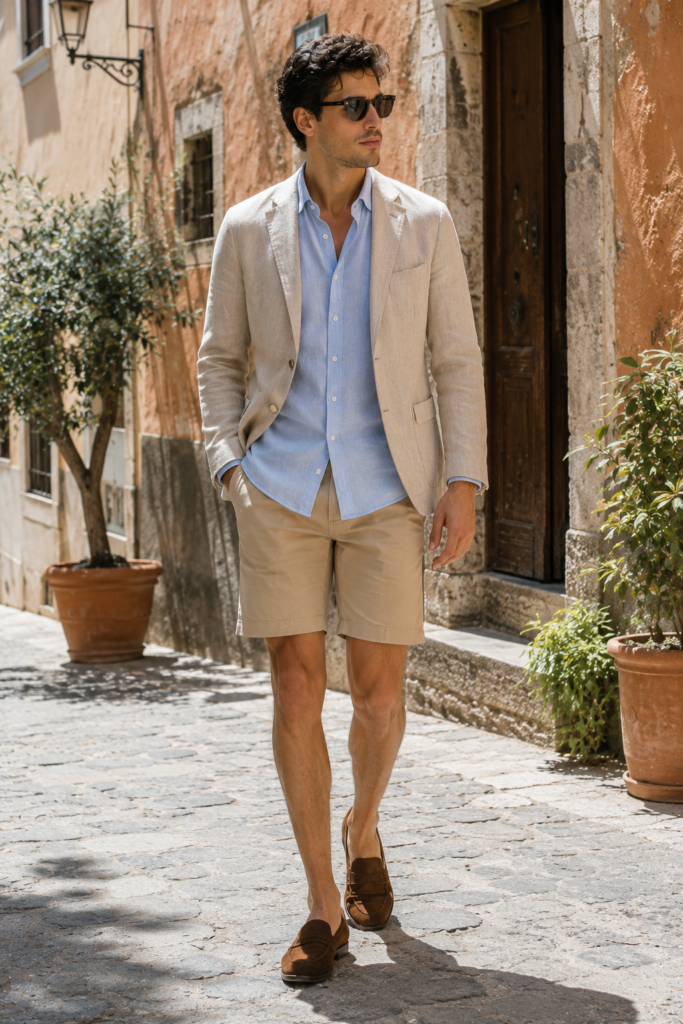
An unstructured linen-cotton blazer, an untucked Oxford shirt, and chino shorts is the outfit for a transitional day that still needs some polish — an outdoor work event, a nicer lunch, a slightly dressed-up weekend occasion.
The blend matters specifically here: a linen-cotton blazer holds a bit more structure than pure linen (which can look overly relaxed or wrinkled) while still breathing better than a wool or poly-blend blazer built for cooler months. Wearing the shirt untucked with shorts, rather than tucked with trousers, keeps the whole outfit from reading as too formal for a transitional-weather daytime event.
Common mistake: wearing this exact combination with dress trousers instead of shorts. The blazer’s already doing the formality work — pairing it with shorts keeps the outfit from tipping into full business-casual, which can feel mismatched for daytime transitional weather.
9. Flannel Shirt Worn Open, Plain Tee, and Denim Shorts
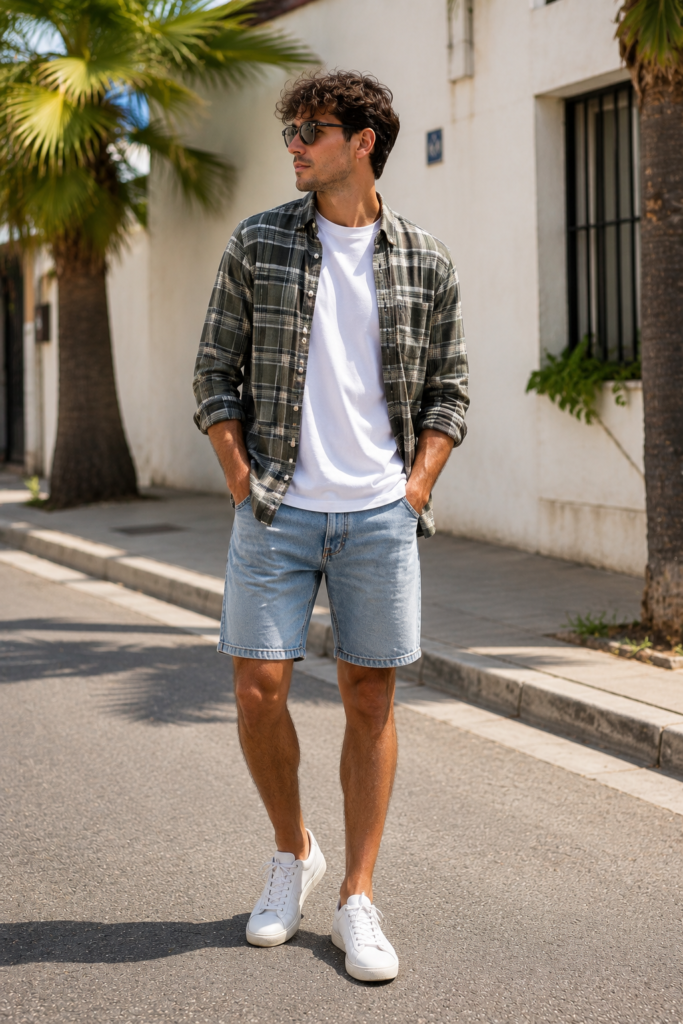
A lightweight flannel shirt (cotton, not heavy wool flannel), worn open over a plain tee, paired with denim shorts, is a genuinely versatile transitional look — warm enough over the tee for a cool morning, easy to tie around your waist once the day heats up.
Flannel’s brushed cotton surface traps a bit of warmth through texture rather than fabric weight alone, which is why a lightweight cotton flannel can add real warmth without being nearly as heavy as a classic winter flannel shirt. Denim shorts underneath keep the bottom half of the outfit already summer-appropriate, similar to the trucker jacket combination earlier in this list.
Best for: cool mornings transitioning to warm afternoons, casual daytime settings.
10. Utility Jacket, Henley Shirt, and Straight-Leg Trousers
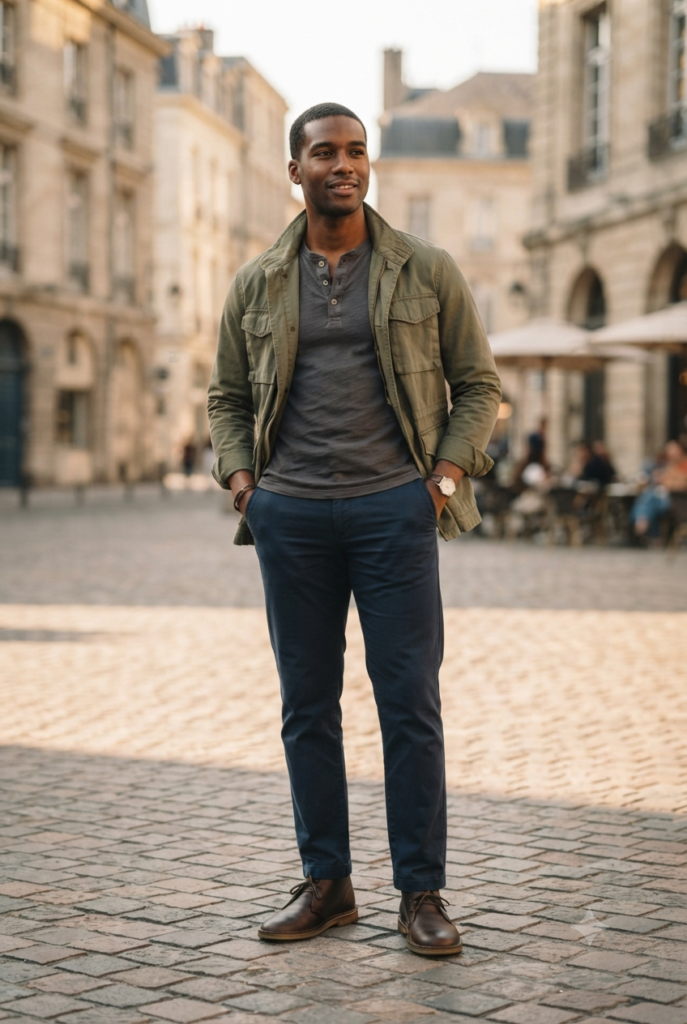
A lightweight canvas or cotton utility jacket, a Henley shirt (a collarless pullover with a button placket), and straight-leg trousers create a slightly more rugged, textured transitional outfit with real function built in.
Utility jackets typically include several functional pockets, which are worth using rather than just displaying — genuinely useful for a season where you might be carrying sunglasses, a phone, and a light layer you’ve taken off, all without needing a bag.
A Henley’s button placket adds a small structural detail at the neckline that a plain tee doesn’t have, giving the outfit a bit more visual interest under an open jacket.
Best for: casual daytime outings, outdoor markets, transitional travel days.
11. Cardigan Over a Tee, with Chinos
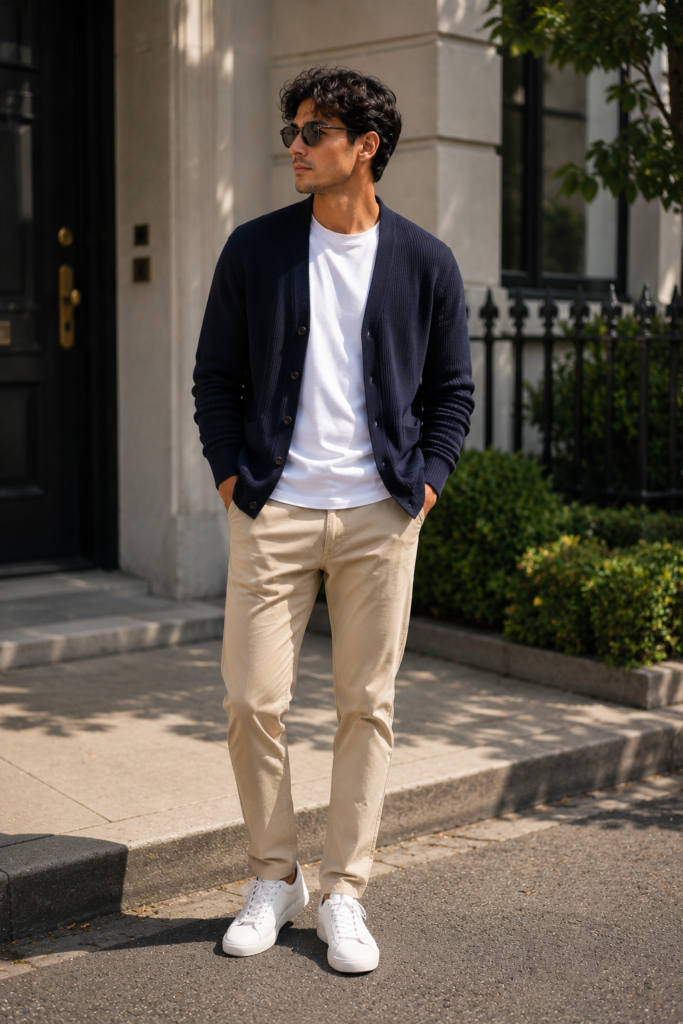
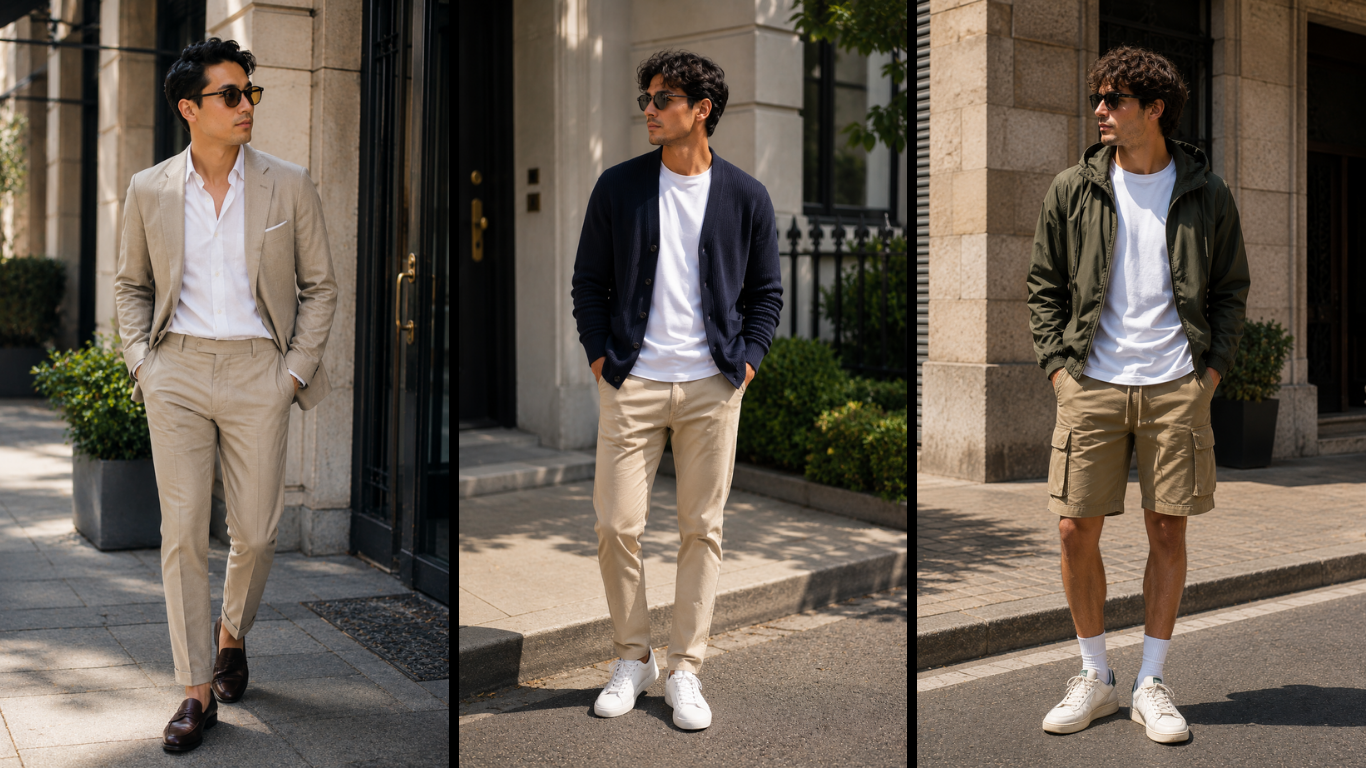
A lightweight, unstructured cardigan (cotton or a cotton-linen blend, not heavy wool) worn open over a plain tee, with chinos, is an underused transitional combination that reads as more considered than a hoodie or bomber without sacrificing comfort.
Cardigans work well specifically because they’re easy to half-wear — pushed-up sleeves, worn open, or removed entirely — throughout a day with real temperature swings, more so than a zip-up jacket that reads as more binary (on or off). A lighter knit (rather than a chunky cable-knit sweater) keeps this from skewing too warm once the day heats up.
Common mistake: choosing a heavy, chunky-knit cardigan for this purpose. The bulkier the knit, the less useful it is once actual summer heat arrives, defeating the point of a transitional piece.
12. Denim Shirt Jacket (Not a True Jacket), Tee, and Joggers

A denim shirt jacket — heavier than a standard shirt but lighter and less structured than a true jacket — worn over a plain tee, with tapered joggers, makes a comfortable, low-effort transitional outfit for travel or casual days.
This piece occupies a specific niche between an overshirt and a full jacket: enough denim weight to cut real wind and add warmth, but no lining or shoulder structure to trap heat the way an actual denim jacket does. Tapered joggers balance the slightly boxier cut of a shirt jacket better than a wide-leg pant would, keeping the silhouette from reading as shapeless.
Best for: travel days, casual errands, low-effort but intentional outfits.
13. Waxed or Coated Cotton Jacket, Rugby Shirt, and Chinos
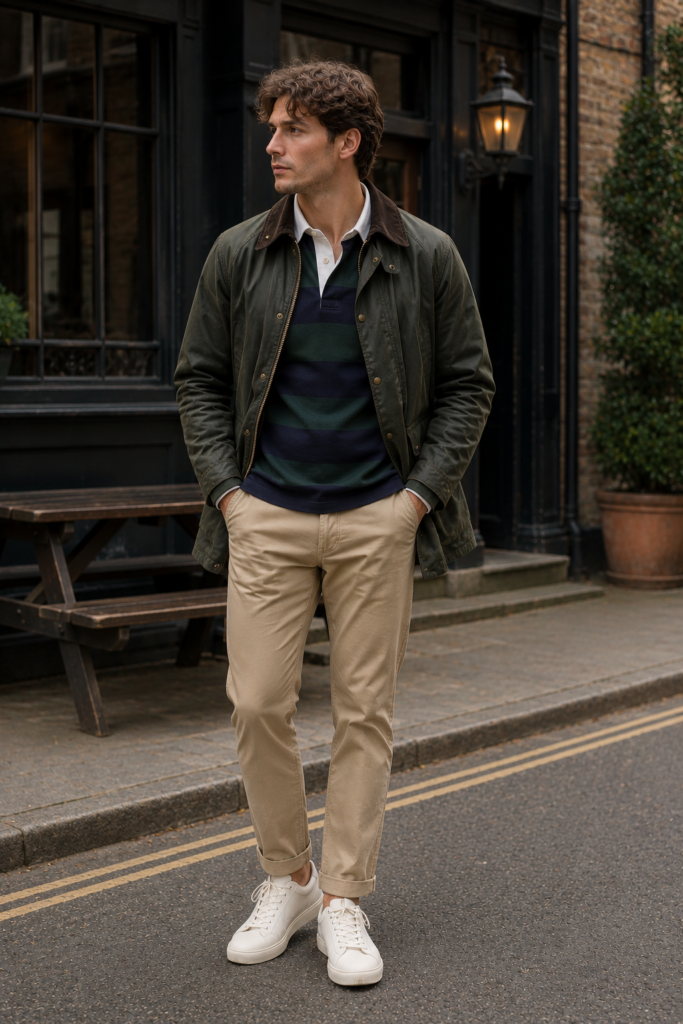
A lightweight waxed or coated cotton jacket, a rugby shirt, and chinos handle the actual rain that often comes with spring-to-summer transitional weather, while still looking considered rather than purely functional.
Waxed cotton’s coating adds water resistance without the bulk of a true rain shell, which matters if you’re dealing with occasional spring showers rather than sustained heavy rain. A rugby shirt’s heavier cotton construction and structured collar hold up well under a jacket, providing enough visual interest that the outfit doesn’t look flat once the jacket’s removed indoors.
Best for: unpredictable rainy transitional days, outdoor events with a chance of light rain.
14. Track Jacket, Tee, and Track Pants (or Chino Shorts)
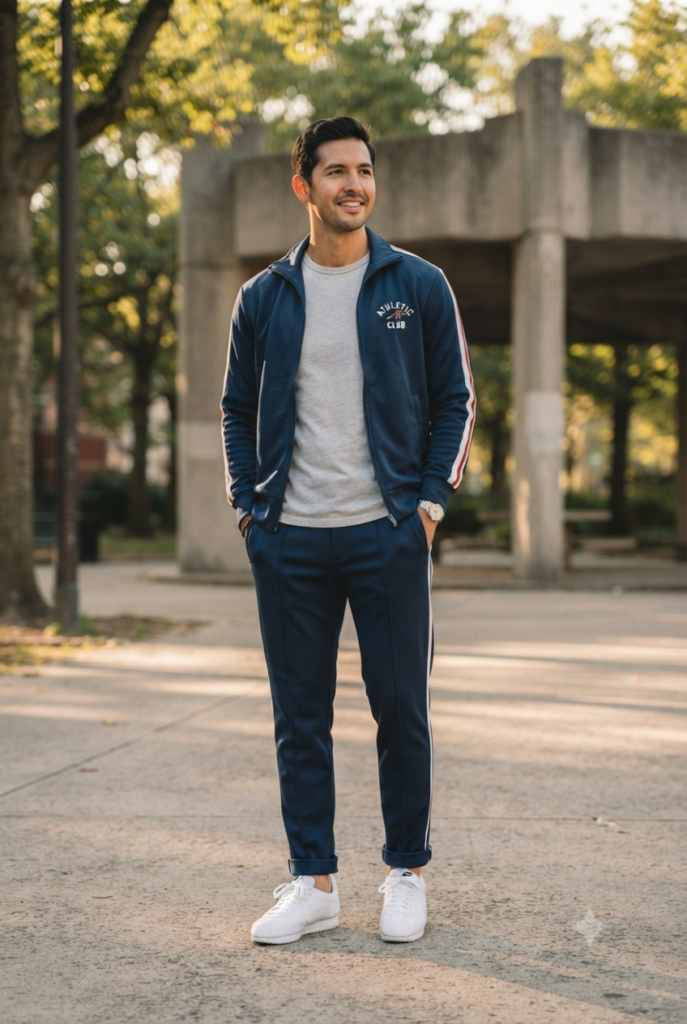
A lightweight, zip-up track jacket, a plain tee, and either tapered track pants or chino shorts underneath make one of the most functional transitional outfits here — genuinely easy to adjust as the day’s temperature shifts.
Track jackets are typically made from lightweight technical or poly-blend fabrics that add wind resistance without much actual insulation, which is close to ideal for a day that starts brisk and ends warm — you’re blocking wind chill more than trapping heat. Pair with track pants for a fully athletic-leaning outfit, or swap in chino shorts underneath for a slightly more put-together daytime look once you remove the jacket.
Best for: casual athletic-leaning outfits, travel, high-movement days.
15. Corduroy Overshirt, Tee, and Lightweight Chinos
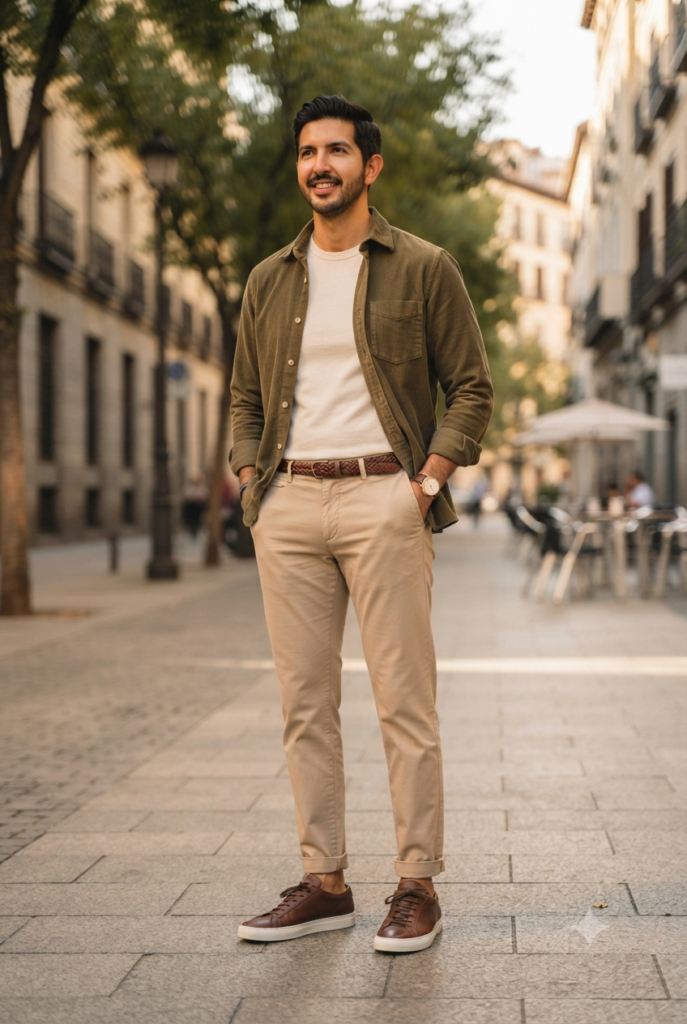
A lightweight corduroy overshirt (thin-wale, not the heavier winter variety), a plain tee, and lightweight chinos add texture and warmth appropriate for a cooler transitional day, without the bulk of true winter corduroy.
Corduroy’s ribbed texture (measured in “wale count” — the number of ridges per inch) determines how heavy the fabric feels; a higher wale count (thinner ridges, like 16-wale) is considerably lighter and more transitional-appropriate than a low wale count (like 8-wale), which is genuinely a winter-weight fabric. This distinction matters if you’re shopping specifically for transitional pieces — check the wale count, not just the fact that it’s corduroy.
Best for: cool transitional days, casual daytime settings with texture-forward styling.
16. Hooded Windbreaker, Tee, and Cargo Shorts
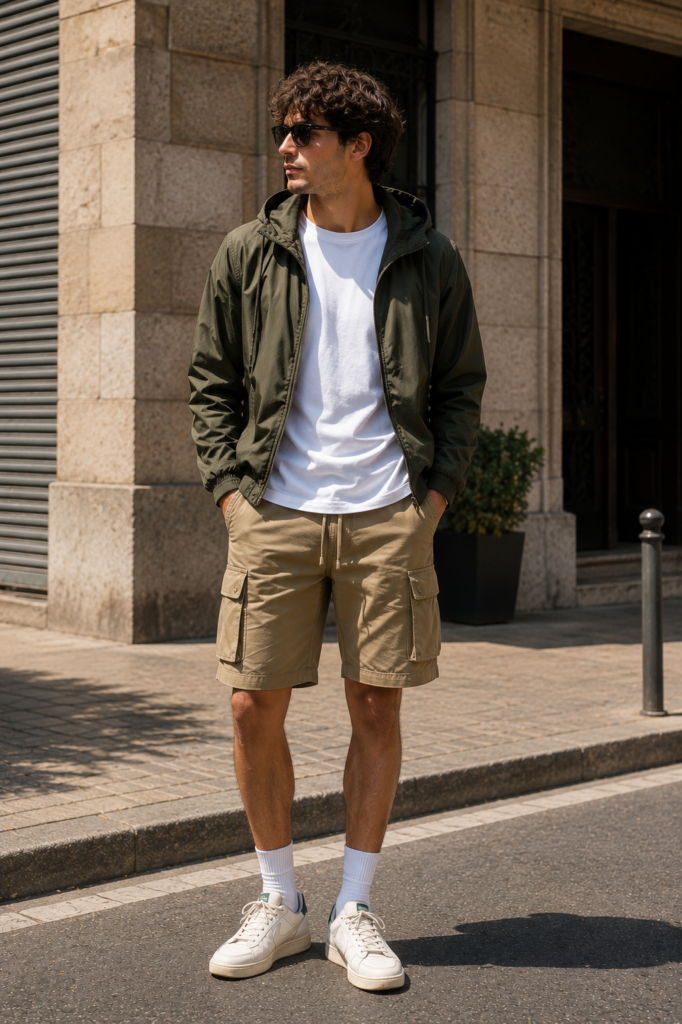
A lightweight hooded windbreaker, a plain tee, and cargo shorts (slim through the thigh) create a genuinely functional transitional outfit for days with real wind or light rain in the forecast.
Windbreakers are built from thin, tightly woven synthetic fabric specifically to block wind rather than trap heat, which makes them one of the lightest true outer layers available — useful for a jacket you might be carrying more than wearing once the wind dies down. Slim-fit cargo shorts keep the outfit from looking bulky under an already voluminous jacket silhouette.
Best for: windy transitional days, outdoor events, travel where packability matters.
17. Cotton Suit Separates, No Tie, Open Collar
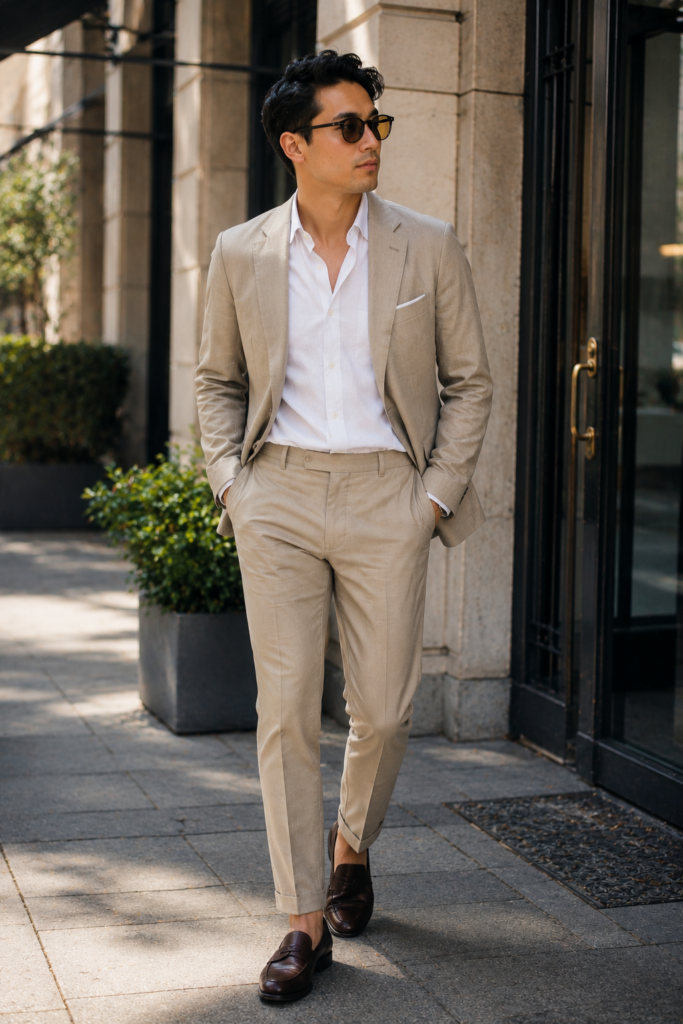
Cotton suit separates — a blazer and trousers, not necessarily matching in exact shade — worn with an open-collar shirt and no tie, handle a transitional business-casual or slightly dressier daytime setting without the weight of a true wool suit.
Cotton holds a cleaner, more structured line than linen while still breathing better than most wool suiting fabrics, which makes it a reasonable middle-ground choice for spring-to-summer business settings where a full wool suit would be too warm but shorts would be too casual. Leaving the top button open, without a tie, keeps the whole outfit from reading as more formal than the transitional-weather context calls for.
Best for: transitional business-casual settings, client meetings, semi-formal daytime events.
18. Layered Tee Under an Open Camp Collar Shirt, with Chino Shorts
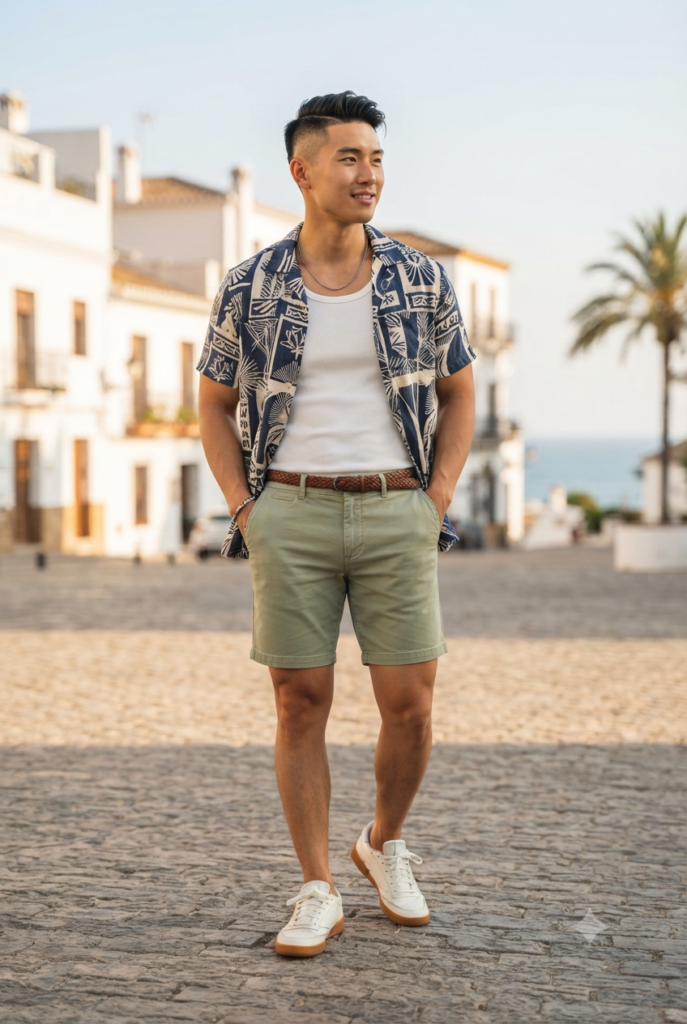
A simple, often-overlooked transitional combination: a plain tee worn under an open, short-sleeve camp collar shirt, with chino shorts — no actual outerwear layer, just enough visual layering to look considered on a day that’s warm but not yet full summer heat.
This isn’t a warmth-driven combination so much as a styling one — the layered look reads as more finished than a single tee alone, without adding real heat, since both pieces are lightweight short-sleeve options. It’s a useful outfit for days that are genuinely warm enough for summer clothes but you still want the outfit to look a bit more put-together than just a tee and shorts.
Best for: warm transitional days that don’t need real warmth layers, casual daytime settings where you still want a finished look.
Why Layering Logic Changes Between Spring and Summer
The core skill in transitional dressing isn’t owning special “transitional” clothes — it’s understanding which layers can be removed without leaving an unfinished-looking outfit underneath. A jacket over a plain tee and shorts works because the tee and shorts are already a complete summer outfit on their own; a jacket over a dress shirt and no other visible layer can look incomplete once removed. Build transitional outfits from the bottom up: make sure what’s underneath the outer layer already works as a stand-alone summer outfit.
Fabric Weight Is the Real Difference-Maker in Transitional Pieces
Nearly every outfit above specifies a lighter version of a normally heavier fabric — unlined field jackets, lightweight corduroy, thin cotton flannel, unstructured cotton-linen cardigans. That’s not a coincidence; it’s the actual mechanism that makes a piece transitional rather than simply a cold-weather item worn too early in the year. When shopping for transitional layers specifically, look for words like “unlined,” “lightweight,” or a specific lower fabric weight listed in the product description, rather than assuming a piece works for the transition just because it’s the right silhouette.
Building a Capsule for Unpredictable Weather
A small collection of versatile layering pieces — one overshirt, one lightweight jacket, one cardigan or quarter-zip — worn over a base of already-summer-ready tees and shorts will get you through nearly every transitional-weather scenario without requiring separate “spring” and “summer” wardrobes. The goal is fewer, smarter pieces that recombine, not a full seasonal wardrobe overhaul every few weeks as the weather shifts.
Frequently Asked Questions
What’s the single most useful piece for spring-to-summer transitional dressing? An overshirt is arguably the most versatile single piece, since it works buttoned as a warmth layer on a cool morning and open (or tied around your waist) as the day warms up, without needing to be swapped out or carried separately.
How do I dress for a day that starts cold and ends hot without carrying extra clothes? Build the outfit so the base layer (tee and shorts, or a tee and lightweight trousers) is already a complete summer-ready outfit, then add one easily removable layer — an overshirt, cardigan, or lightweight jacket — that can be tied around your waist or carried once it’s no longer needed.
Are heavier fabrics like corduroy or flannel ever appropriate in warmer transitional weather? Yes, as long as you choose lighter-weight versions — thin-wale corduroy or lightweight cotton flannel rather than heavy winter-weight versions of the same fabric. The fabric weight, not just the fabric type, determines whether it works for transitional weather.
Should I choose synthetic or natural fabrics for transitional layering pieces? Both have a place: technical synthetics (windbreakers, track jackets) are better for blocking wind and light rain without much insulation, while natural fibers (cotton, linen blends) tend to be more comfortable for everyday wear and breathe better once you’re indoors or the day warms up.
What’s the biggest mistake men make with transitional dressing? Wearing a genuinely heavy, insulated layer (a lined jacket, a chunky wool sweater) that’s too warm once the day heats up, with no easy way to remove it and still have a complete-looking outfit underneath.
Can suit separates work for transitional weather without a full suit? Yes — pairing a blazer with trousers or shorts that don’t necessarily match creates a more casual, transitional-appropriate look than a full matching suit, while still offering more structure and polish than a t-shirt and shorts alone.
How many transitional layering pieces do I actually need? Three or four versatile pieces — an overshirt, a lightweight jacket, and a cardigan or quarter-zip — are generally enough to cover the range of transitional weather, especially if they’re neutral in color and pair easily with a range of base outfits.
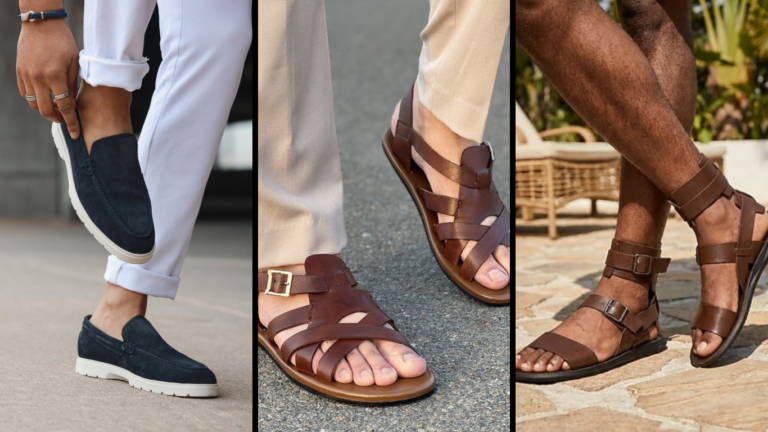
Do I need different shoes for spring-to-summer transitional outfits? Not necessarily a full separate rotation — a versatile sneaker or desert boot generally works across both cooler transitional mornings and warmer afternoons, while true sandals and slides are better saved for once temperatures are consistently warm.
What fabric weight should I look for when shopping for transitional pieces specifically? Look for terms like “unlined,” “lightweight,” or a specifically lower gsm or ounce weight listed in the product description — these are more reliable indicators of a transitional-appropriate piece than the general fabric type alone.
Is it worth buying pieces specifically labeled for spring or “transitional” seasons, or can I just buy lighter versions of normal pieces? Buying lighter-weight versions of pieces you’d already own — an unlined jacket instead of a lined one, a lightweight cardigan instead of a chunky sweater — is generally more cost-effective and versatile than buying pieces marketed specifically as “transitional,” which often cost more for the same underlying fabric-weight logic.
Transitional dressing isn’t about owning an entirely separate wardrobe for a few unpredictable weeks — it’s about understanding which of your existing pieces can layer on top of an already-complete summer outfit, and choosing lighter versions of your usual cold-weather layers when you do need to buy something new. Get that logic down, and the shift from spring into full summer heat stops being a wardrobe problem and just becomes a matter of what you decide to take off partway through the day.
Read also: